
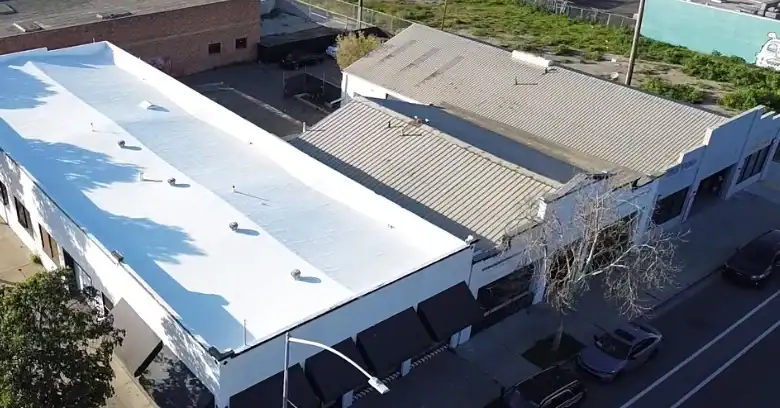
Comparing Commercial Roofing Services Across Central Coast California?
Creative Roofing handles building roofs with an eye on drainage, access and daily operations, for properties in Central Coast California and the surrounding area.
Contact us at 805-723-2381 to talk through a commercial roof question.
Why a Building Roof Is a Different Animal
Low slopes make a commercial roof a different problem from a house roof, and that is worth keeping in mind. Flat roofs rely on continuous membranes with welded or glued seams, and a small gap can become a large leak.
Buildings also carry people, stock and equipment that a leak can ruin, and a dry building is the whole point.
Common Low-Slope Roof Systems
Single-ply membranes such as TPO, PVC and EPDM are among the most common coverings on commercial buildings, and the details are worth a closer look. Layered bitumen roofs remain common on buildings of every age, and it is easy to overlook. Coated metal panels have become common on newer low-rise construction, and the right answer depends on what is already on the roof.
Drainage Is Everything on a Flat Roof
Standing water is the most common enemy of a low-slope roof, and it pays to think it through. Leaves, seed pods and windblown trash gather in corners and drains over the summer, so clearing drains is the cheapest maintenance on the list.
Working Around Machinery
Heating and cooling units, exhaust fans and vents sit on most commercial roofs, and sealants alone are rarely a lasting fix. Walkway pads protect the routes that technicians use most often, and a contractor can mark them on the roof.
Heat Over a Working Building
Direct sun heats a dark roof to a temperature far above the air, and that is why white and light membranes are so common. Owners often look at reflective roofing for the savings on cooling, and local rules may favor reflective surfaces on some projects.
Planned Roof Care
Routine care costs a fraction of an emergency repair, and it gives you a record to show a buyer or lender. Typical upkeep includes clearing drains, checking seams and sealing small cracks, and the details are worth a closer look.
Repair, Coat or Replace
A sound roof with surface wear can sometimes be restored with a coating, and saving a good roof is cheaper than replacing it. A roof that is wet inside cannot be coated or patched into good health, and that is worth keeping in mind.
Scheduling and Safety
Roofers often work in phases so a store can stay open, and early notice prevents most problems. Access to the roof should be controlled while the work is in progress, and a little care goes a long way.
Making Sense of Competing Bids
A good proposal should say what will be removed, what will be installed and how the edges will be finished, and the difference is often in what is not mentioned. Ask how the work will be inspected and what documentation will be provided at the end, and it is easy to overlook.
Finding the Source of a Commercial Leak
Tracing a leak on a low slope takes patience, because water wanders, and guessing leads to repairs in the wrong place. Penetrations and terminations are the usual suspects, and fixing the cause stops the leak for good. Moisture scans and core samples can show how far water has spread inside the roof, so it is worth asking about on a larger roof.
How Wind Affects a Flat Roof
Wind lifts a flat roof from the edges and corners first, and repairs there should not wait. Coping and edge flashing should be firmly attached and free of gaps, and a gap there can grow quickly in a gust.
Where the Roof Meets the Building
Parapets are the short walls that rise around the edge of many commercial roofs, and that is worth keeping in mind. Stucco, masonry and metal walls each need a different kind of termination, and ignoring it can undo a good roof.
Coatings Explained
Restoration coatings are meant for roofs that are still basically sound, and the right product depends on the existing membrane. Coating over a wet roof is a common and costly mistake, and an honest contractor will say so.
Large Roofs, Warehouses and Retail Centers
Warehouses and distribution buildings often have very large, uninterrupted roofs, and it is easy to overlook. A leak in one unit may start above the next one down the line, so the plan should name each area. Apartment and multifamily buildings add residents, balconies and shared walkways to the mix, and good communication is part of the job.
Spending Wisely on a Flat Roof
Treating the roof as an asset with a lifespan is the smart approach, and a good report gives a reasonable range of years remaining. The cheapest proposal is not always the best value, and the details are worth a closer look.
Insulation and Cover Boards
Foam or fiberboard panels are laid over the deck and covered by the membrane, and wet boards lose most of their value. Cover boards add a firm surface that protects insulation from foot traffic and hail-free impacts, so many owners include it. A tapered plan can be drawn for any roof and installed with the new membrane, and few owners regret it.
A Seasonal Checklist for Managers
Written notes from each seasonal visit build a record that helps with budgeting and with conversations about replacement, and a little care goes a long way.
Let Us Know What You Are Dealing With
A conversation about Commercial Roofing Services in Central Coast California usually starts with the age and type of the roof, and 805-723-2381 reaches someone who can help. Even a quick conversation can clarify what the building needs, and the roof will tell the story once someone looks. A visit to the property turns a general worry into a specific plan, and the conversation can be brief. Good records and photographs make those conversations easier, and the paperwork can be kept with the building file.






















