
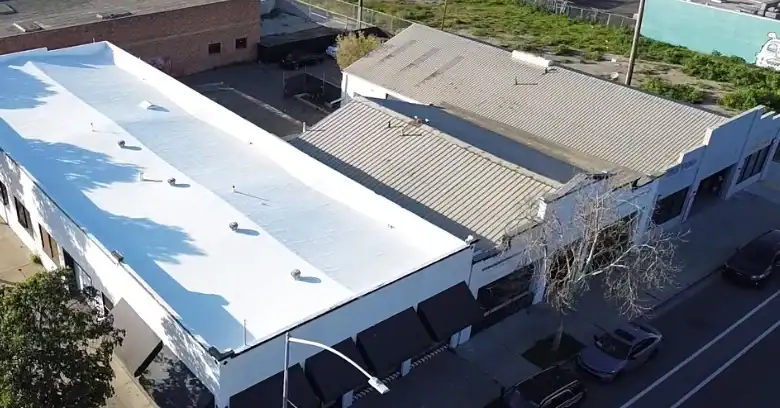
Comparing Commercial Roofing Installation for a Building in Central Coast California?
Creative Roofing looks after the roof over a business, from a small storefront to a large building, wherever a building needs a sound roof around Central Coast California.
Contact us at 805-723-2381 to talk through a commercial roof question.
Roofs Over Businesses
Low slopes make a commercial roof a different problem from a house roof, so the finer points carry the weight. Waterproofing on a low slope comes from the sheet itself rather than from the angle, and there is little margin for sloppy work.
Buildings also carry people, stock and equipment that a leak can ruin, and regular checks pay for themselves.
What Building Roofs Are Made Of
Rolled single-ply sheets are widely used because they are light, reflective and quick to install, and the differences matter when comparing proposals. Layered bitumen roofs remain common on buildings of every age, and they suit many situations where traffic and equipment are heavy. Coatings over an existing sound roof can extend its life without a tear-off, and each option has conditions where it works best.
Where the Rain Goes
Water that sits on a membrane ages it faster than water that runs off, and it pays to think it through. Sun-dried debris sits on a roof all through the dry season, and the first heavy rain turns it into a plug.
Air Conditioners, Vents and Curbs
A roof with a lot of equipment has a lot of penetrations to maintain, and the flashing around each one has to be right. Service technicians walking to equipment can wear a path through a membrane, and it is easy to overlook.
How the Climate Affects a Building Roof
Direct sun heats a dark roof to a temperature far above the air, and that is why white and light membranes are so common. Reflective membranes and coatings can lower the temperature of the roof and the space beneath it, and local rules may favor reflective surfaces on some projects.
Small Jobs That Prevent Big Ones
Scheduled inspections catch small problems before they reach the ceiling, and a little care goes a long way. Maintenance work is mostly cleaning, tightening and resealing, and most items take only a short time.
Choosing the Right Level of Work
Localized damage can be repaired without touching the rest of the roof, so ask for evidence before agreeing to a plan. Replacing only the surface over saturated insulation hides the problem without solving it, so a clear diagnosis matters.
Keeping the Business Running
A good plan keeps customers and staff away from the areas under construction, and it pays to think it through. Anyone entering the roof during construction needs to be accounted for, so ask how the site will be protected.
Reading a Roof Proposal
Look for details about seams, terminations and penetration flashing, and the difference is often in what is not mentioned. The paperwork at the end of a job is as important as the work itself, and keep it with the building records.
Why the Drip Is Never Where the Hole Is
Tracing a leak on a low slope takes patience, because water wanders, so a careful inspection is worth the time. The edges and the corners are where a flat roof tends to give way first, and it pays to think it through. A survey gives facts to base a decision on, and a little care goes a long way.
Perimeter Details and Attachment
The edges and corners of a flat roof take the highest wind loads, so careful edge details are a mark of good work. Loose trim lets wind get under the membrane and peel it back, and a gap there can grow quickly in a gust.
Terminations and Transitions
Flashing at the wall is one of the most failure-prone parts of a low-slope roof, so the height and the termination are both important. Stucco, masonry and metal walls each need a different kind of termination, so it helps to look at the wall as well as the roof.
Fluid-Applied Systems
Restoration coatings are meant for roofs that are still basically sound, and the preparation matters as much as the product. Applying a coat over a roof that is already saturated traps moisture and hides the problem, and ask for the test results first.
When the Roof Covers an Acre
Large roofs pose logistical problems that small ones never do, and weather windows matter more at this scale. A leak in one unit may start above the next one down the line, and a single contractor for the whole roof keeps things simple. Roofs over housing need extra care to keep people safe and informed, and it pays to think it through.
Thinking About Cost Over the Life of the Roof
A reserve for the eventual replacement keeps the decision calm, and a little care goes a long way. Choosing on the lowest initial figure alone can cost more over the life of the building, and the details are worth a closer look.
Insulation Under the Membrane
Most commercial roofs have rigid insulation boards between the deck and the waterproofing, and they are protected by the membrane above. A sturdier base means fewer punctures and longer service, and the result is a tougher roof. Angled boards direct water toward drains and reduce ponding, and it is a good time to ask about it.
A Seasonal Checklist for Managers
A pre-season checklist includes clearing drains and scuppers, checking seams and flashing, and photographing the condition of the surface, and a little care goes a long way.
Talk to Us About Your Building
Owners comparing Commercial Roofing Installation in Central Coast California can start by describing the building and what concerns them, and 805-723-2381 reaches someone who can help. There is no pressure in asking questions about a roof, and we are glad to help you sort it out. Most building owners find that a short call clears up more than weeks of wondering, and the roof will show the rest. Property managers often juggle many buildings and appreciate clear, written answers, so it pays to begin early.






















