
Thinking About Clay Tile Roofing Contractors for a Home in Nipomo California?
Creative Roofing works with clay and concrete roofing units, from a single cracked piece to a full re-lay, serving homeowners in Nipomo California and beyond.
Reach us at 805-723-2381 to talk through what a tile roof needs.
Basics of a Roof Built From Individual Pieces
Every piece is shaped to channel water downhill and over the piece below, and the overlap lets water run off quickly. Concrete units are molded from cement and sand and colored through the body or on the surface, so samples help with the choice.
Weight, Framing and What the House Can Carry
The weight of the roof is the first question to settle before changing from lighter material, so a visual check is where the process begins. Even a roof originally built for heavy units can lose strength over time if water has damaged the wood, and a careful contractor raises the issue unprompted.
Felt, Membranes and Battens
Beneath the visible surface lies a waterproof membrane that does the hard work, and it ages in the heat trapped under the pieces. A roof can look perfect from the street and be failing underneath, so ask what product will go under the units.
Why Tile Suits Hot Weather
The pieces rarely wear out from sun alone, which is why a well-built roof can last so long, and that is why roofs of this kind are so common in warm regions. Efflorescence, a white powdery bloom, can show on concrete units and is mostly cosmetic, and a roofer can tell the difference.
Why Pieces Break
A piece cracks when someone steps on the wrong spot, and many are broken by workers on the roof for other reasons, and the details are worth a closer look. Anyone who walks a roof of this kind needs to know where to step, because the wrong spot breaks the piece, and it is easy to overlook.
Where Pieces Meet Walls and Each Other
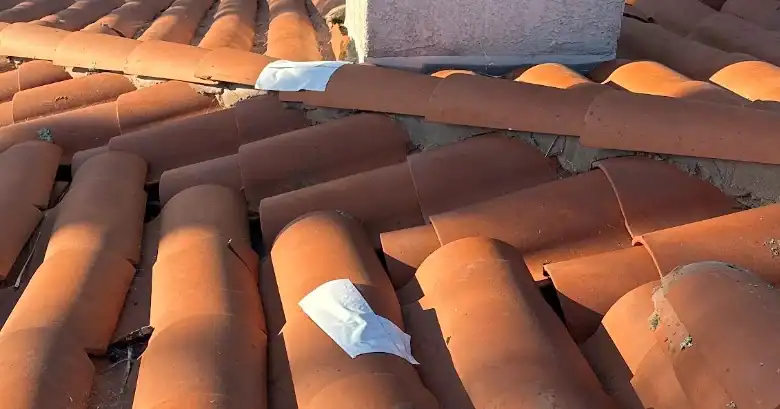
Every junction on the roof is a place where craft decides the outcome, and a hurried job shows up in the first heavy rain. Cracked and crumbling mortar along the ridge lets water and wind get under the cap pieces, and the repair is far less costly than water damage.
Wind, Fire and the Fastening Question
Some systems use a mechanical clip at every piece, while others rely on adhesive along the edges, and a little care goes a long way. Clay and concrete are noncombustible, which is a strong advantage in a region with wildfire seasons, and local rules may set requirements for roof assemblies.
Options for a Tired Roof
A re-lay means lifting the units, replacing the underlayment and flashing, and setting the pieces back in place, and the savings from a re-lay can be considerable. If the pieces are worn out, a re-lay would only reuse tired material, so it is a time to consider all the options.
Adhesives, Clips and Mortar
Older roofs of this kind used mortar to bed the ridge and hip pieces and to seal the edges, and that mortar eventually cracks and crumbles, and be wary of mortar alone on a ridge. Eave closures and bird stops fill the gap beneath the lowest course, keeping out birds, rodents, leaves and windblown embers, and a little care goes a long way.
Moss, Stains and Keeping the Surface Clean
Dust, pollen and shade can leave a roof of this type looking dull and streaked, even when it is perfectly sound, and the result can be striking. High pressure is the wrong tool for a roof made of individual pieces, because the water is driven uphill under the laps, and a post-cleaning inspection is a good idea.
Felt, Synthetic and Self-Adhering Options
Choosing a durable underlayment is one of the best investments in a long-lived roof, since it is the layer that has to outlast the rest, so ask which product is specified. Battens that lift the units off the underlayment allow air to circulate and water to drain freely beneath the pieces, and the extra layer is inexpensive protection.
Rooftop Additions on a Roof of Many Pieces
The best time to add rooftop equipment is when the roof is being re-laid, because the openings can be built in properly, so coordinate the roofer with any other trade. A roofer can place a few walkway planks or marked steps to protect the routes that others will use, and replacing a unit is far cheaper than repairing the leak. Valleys and low points on a roof of this kind carry the heaviest flow in a downpour, and the units along their edges are cut to fit and sealed with care, and a ladder and a soft broom are often all you need.
Choosing Between Clay and Concrete
Cast from cement and sand, concrete units take their color from pigment in the mix or from a coating applied to the surface, so ask to see samples of both. Profiles vary from the rounded barrel shape seen on Spanish and Mediterranean homes to flat slabs and interlocking designs that look like slate or shake, and take your time with the choice.
How to Weigh Two Bids
A proposal that only says re-lay the roof does not tell you enough, and compare two bids line by line. Ask how the crew will handle the pieces, where they will be stored and how breakage will be managed, and trust the tone of the conversation.
From Lifting the Units to Setting Them Back
Work in stages keeps the house covered at the end of every day, so that a sudden rain does not find an open roof, and it is easy to overlook.
Preparing for Dry Winds and Embers
Closure strips at the eaves and the ridge keep embers and animals out of the space beneath the units, and that is worth keeping in mind.
Keeping Track of a Long-Lived Roof
A note of the underlayment type, the flashing metal and the fastening method helps any roofer who works on the roof later, so ask the roofer for copies.
Talk to Us About Your Roof
Anyone sorting out Clay Tile Roofing Contractors in Nipomo California is one call away from a straight answer, and the number is 805-723-2381. Whether the roof is leaking now or you are planning ahead, an early conversation keeps your options open, and the first step is just a phone call.
Verified

Verified
Verified
Verified
Verified






















