
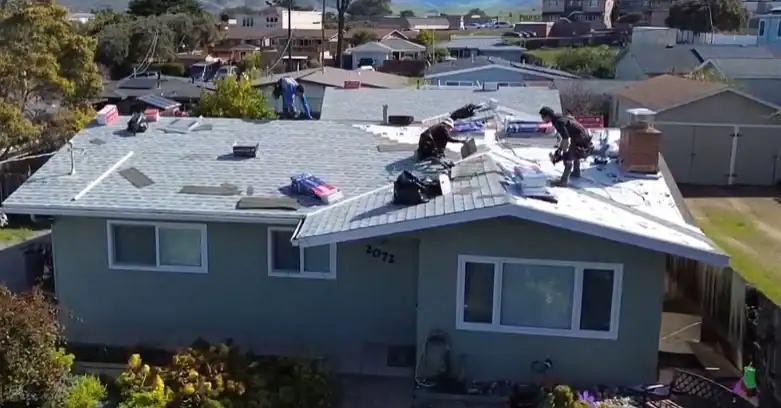
Looking for Roofing Companies for a Home in San Luis Obispo California?
Creative Roofing handles the planning, the tear-off and the cleanup of a roof job, from San Luis Obispo California out to the surrounding area.
Phone 805-723-2381 and tell us what has you thinking about the roof.
The First Step in a Roofing Project
Before any material is chosen, the existing roof has to be understood, and the notes from that visit steer every later choice. The roofer checks the surface, the flashing, the vents and the gutter line, then the attic if it can be reached, and that is the evidence a sensible plan is built on.
Sunny slopes and shaded slopes tell different stories, and both matter, so the wear is rarely even from one side to the next.
Deciding What the Roof Needs
A roof can be repaired, partly rebuilt or removed entirely, and the evidence decides what is done, so a clear explanation matters more than a quick quote. Damage should be shown rather than only described, and the answer tells you a lot.
Hidden damage found during tear-off is the usual reason a project grows beyond its first outline, and nobody should be surprised when it happens.
Choosing Materials for Your Home
Asphalt shingles, concrete or clay tile and standing seam metal are the coverings most often put on homes here, and the style of the neighborhood often plays a part. Sun exposure makes color a practical question as well as a visual one, and it pays to look at them at different times of day.
The Calendar and the Forecast
Roof work is easiest to schedule in the long dry stretch between rains, and crews watch the forecast closely. Roof surfaces get hot enough in July to change how materials behave, and finishing early keeps people and materials in better shape.
Stripping Down to the Deck
The existing covering is stripped away and the deck is left exposed for inspection, and debris goes into a bin or trailer rather than onto the lawn. Soft or split sheathing is cut out and new panels are fastened down, so this is not the place to save time.
Protection Under the Covering
The surface you see is only the outer layer of a roof, and chimneys get particular care. The house is safest once the second layer is complete, and the finished surface is installed over a sound base.
Flashing and the Fiddly Parts
The places where a roof is interrupted are the places most likely to leak, and it pays to think it through. Vent boots and pipe collars are rubber or lead pieces that wear out before the roof does, so this is an easy step to ask about.
Intake and Exhaust
Heat collects in the space beneath the roof deck unless it has somewhere to go, since warm air rises on its own when it is given a path. Adding vents at random may do little more than cut holes in the roof, so ask how the attic will breathe once the work is done.
The Last Day on Site
A finished roof still leaves a yard full of scraps, nails and packaging, so gutters are checked and cleared of loose granules. Questions are easier to settle while the crew is still on site, and a saved record answers questions nobody has thought to ask yet.
Permits and Paperwork
Replacing a roof usually involves the local building department in some way, because surprises at the counter slow everything down. Fire safety rules in some neighborhoods affect which coverings are allowed, since the covering you pick has to be one the town accepts. The best paperwork leaves little room for misunderstanding, and it is worth reading it slowly.
What Happens to the Yard
Roof work is hard on landscaping unless it is planned for, and it is reasonable to ask how this will be done. Children and animals should stay clear of the yard while the work is underway, so tell the crew about anything fragile or valuable. Attic contents are best covered or moved before the work starts, and a sheet over stored boxes keeps the grit off.
The Few Days of Commotion
A new roof usually takes a few days for an average house, though weather and size change that, so ask for the expected start and finish up front. Roof work is loud, and the street will hear it, and it is easy to overlook. Pets are often the ones most bothered by the commotion, and that is worth keeping in mind.
A Short List for Comparing Proposals
Find out who will be on the roof and who will be in charge of the job, and it pays to think it through. A proposal that only says shingles or tile is not specific enough, so ask before you sign anything. Surprises are normal, and a process for them is a sign of a well-run job, and the details are worth a closer look.
Keeping a Roof in Good Shape
Regular glances at the roof catch small problems early, and the best times are before the rainy season and after the first big storm. Overhanging trees drop material that collects in corners and valleys, and that is worth keeping in mind. Missing pieces, lifted edges or a new stain are all reasons to have someone look, and a photograph helps explain what you saw.
Spring, Summer or Fall
Planning ahead usually gives better choices than reacting to an emergency, and a calm decision is nearly always a better one. Late summer is hot but dependable, and crews are usually busy, so do not feel the choice is locked in.
Attic Findings That Change the Plan
Rust on the points of roofing nails and dark patches on the sheathing are signs that moisture has been present for some time, and attic problems are cheaper to deal with during a re-roof.
Talk to Us About Your Roof
Sorting out Roofing Companies in San Luis Obispo California is easier with someone who can look at the house, so use 805-723-2381 to talk through the roof and the next step. Every roof is different, so every conversation starts from the house itself, so there is no harm in asking questions first. The sooner the roof is looked at, the more choices you tend to have, and the next step becomes obvious.
Verified

Verified
Verified
Verified
Verified






















