
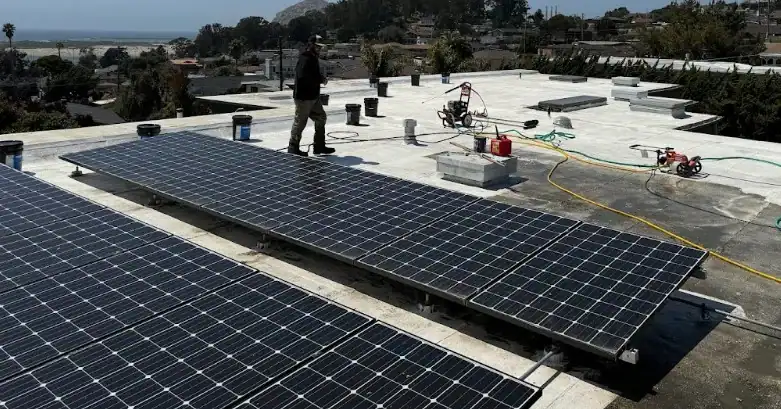
Planning Commercial Roofers for a Building in Atascadero California?
Creative Roofing handles building roofs with an eye on drainage, access and daily operations, serving owners and managers across Atascadero California.
Contact us at 805-723-2381 to start planning the work with someone who knows low-slope roofs.
Commercial Roofs Are Not Bigger Houses
A building roof is built around drainage and access rather than steep pitch, and that is worth keeping in mind. Flat roofs rely on continuous membranes with welded or glued seams, so installation craft counts for a great deal.
The cost of a failed roof is often higher inside the building than on top of it, so planning ahead is the practical approach.
A Look at the Main Systems
Many newer commercial roofs use a single-ply membrane over insulation, and the details are worth a closer look. Asphalt-based systems are proven and repairable but heavier than single-ply sheets, and they suit many situations where traffic and equipment are heavy. Metal roofing is used on some commercial buildings, particularly those with a steeper pitch, and the right answer depends on what is already on the roof.
Drainage Is Everything on a Flat Roof
Every flat roof is only as good as its drainage, and it pays to think it through. Interior drains, edge scuppers and perimeter gutters each have their own failure points, and an overflow scupper is a backup that should never be blocked.
Working Around Machinery
Mechanical equipment on the roof creates dozens of places where the membrane has to be cut and sealed, and many leaks start there rather than in the open field. Foot traffic that is not planned for wears the roof where it matters most, and everyone benefits from the protection.
Heat Over a Working Building
Heat and ultraviolet light age a roof surface more than rain does, and that is why white and light membranes are so common. A cooler roof surface lowers the strain on air conditioning in hot months, so ask a contractor to explain what to expect.
Planned Roof Care
A planned visit twice a year is a common routine for building owners, and a little care goes a long way. Maintenance work is mostly cleaning, tightening and resealing, and most items take only a short time.
Deciding What to Do With an Aging Roof
The right answer depends on how much of the system is still dry and sound, so ask for evidence before agreeing to a plan. A roof that is wet inside cannot be coated or patched into good health, and it is better to know the truth sooner.
Working in an Occupied Building
Roof work above an operating business needs planning so that normal activity can continue, and early notice prevents most problems. Fall protection is required on commercial roofs, and a professional crew uses it, and plan for parking and deliveries as well.
Reading a Roof Proposal
A good proposal should say what will be removed, what will be installed and how the edges will be finished, and the cheapest-looking option may leave things out. The paperwork at the end of a job is as important as the work itself, so make it part of the agreement.
Tracing a Leak Over a Business
Tracing a leak on a low slope takes patience, because water wanders, and the roofer has to follow the evidence across the roof. Penetrations and terminations are the usual suspects, and a good survey starts with those. A survey gives facts to base a decision on, and it helps explain the situation to the people who sign the checks.
Edges Are Where Roofs Let Go
The edges and corners of a flat roof take the highest wind loads, and the details are worth a closer look. A strip of metal that has come away is an invitation for wind and water, and it is easy to overlook.
Walls, Parapets and Flashing Details
Flashing at the wall is one of the most failure-prone parts of a low-slope roof, so the height and the termination are both important. Stucco, masonry and metal walls each need a different kind of termination, and ignoring it can undo a good roof.
Fluid-Applied Systems
Roof coatings are liquid products rolled or sprayed onto an existing roof to form a protective skin, and a coating is only as good as the surface beneath it. Applying a coat over a roof that is already saturated traps moisture and hides the problem, and ask for the test results first.
Large Roofs, Warehouses and Retail Centers
Big projects need a plan for storage, staging and phasing, and the roof can be done in sections. Multi-tenant buildings call for clear communication with every occupant, so the plan should name each area. Planning around families and daily routines matters on a residential property, and good communication is part of the job.
Spending Wisely on a Flat Roof
Thinking about the roof as a recurring cost makes budgeting easier, and nobody likes a surprise expense. Choosing on the lowest initial figure alone can cost more over the life of the building, and the details in the scope explain the difference.
The Layers Below the Surface
The insulating layer is part of the roof system, not an afterthought, and they are protected by the membrane above. Extra layers under the membrane help it resist wear from equipment and walking, so many owners include it. Slope built into the insulation is one of the cleanest ways to fix drainage problems, and the drawings show where the water will go.
Late-Summer Readiness Checks
Rooftop units should be examined for loose panels, failed seals and missing fasteners, since a stray panel can let rain into the system, and a little care goes a long way.
Let Us Know What You Are Dealing With
Managers researching Commercial Roofers in Atascadero California are welcome to call and ask questions, so use 805-723-2381 to set up the next step. Calling sooner rather than later keeps repair costs and disruption smaller, so reach out whenever you are ready. People who manage property tend to value a straight answer about the roof above all, so call when you have a moment. Good records and photographs make those conversations easier, and written records show the property has been cared for.
Verified

Verified
Verified
Verified






















