
Researching Commercial Roofing Services Across Morro Bay California?
Creative Roofing looks after the roof over a business, from a small storefront to a large building, serving owners and managers across Morro Bay California.
Call 805-723-2381 and tell us about the building and the roof.
Commercial Roofs Are Not Bigger Houses
The roof on a store or office is a working surface as much as a cover, so the finer points carry the weight. Waterproofing on a low slope comes from the sheet itself rather than from the angle, and it pays to think it through.
Tenants and staff notice a drip long before an owner sees the cause, and regular checks pay for themselves.
What Building Roofs Are Made Of
TPO, PVC and EPDM are the single-ply families most owners hear about, and each family has its own seam method. Layered bitumen roofs remain common on buildings of every age, and it is easy to overlook. Standing seam metal panels cover warehouses, schools and retail buildings, and each option has conditions where it works best.
Where the Rain Goes
A roof that holds puddles after rain is telling you something, so inspections are best scheduled in late summer. Sun-dried debris sits on a roof all through the dry season, and an overflow scupper is a backup that should never be blocked.
Working Around Machinery
Mechanical equipment on the roof creates dozens of places where the membrane has to be cut and sealed, and many leaks start there rather than in the open field. Walkway pads protect the routes that technicians use most often, and a contractor can mark them on the roof.
Heat Over a Working Building
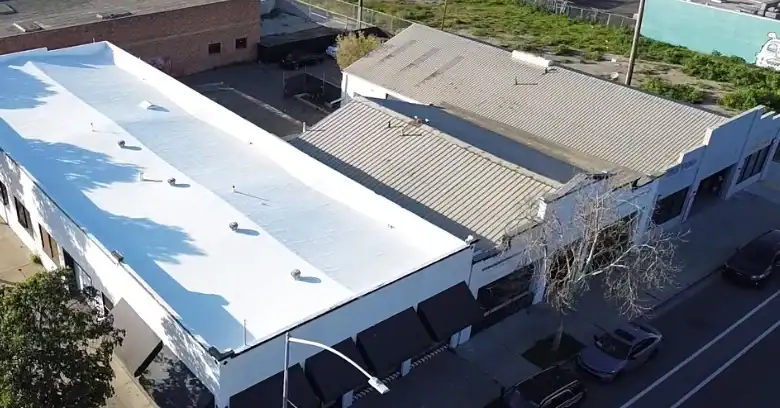
Heat and ultraviolet light age a roof surface more than rain does, and that is why white and light membranes are so common. Cooling load is one of the practical reasons building owners choose a reflective roof, and local rules may favor reflective surfaces on some projects.
Planned Roof Care
A commercial roof lasts longest when someone looks at it regularly, and the best times are before and after the rainy season. Typical upkeep includes clearing drains, checking seams and sealing small cracks, and the results show up in fewer emergency calls.
Choosing the Right Level of Work
Not every aging roof needs a full tear-off, and saving a good roof is cheaper than replacing it. Replacing only the surface over saturated insulation hides the problem without solving it, and it is better to know the truth sooner.
Tenants, Customers and Noise
Work over occupied space is staged carefully to keep people safe and dry, and noisy work can be timed around business hours. Safety at the edge of a roof is a serious matter for the crew and for people below, and that is a reasonable thing to discuss in advance.
Apples to Apples
A clear commercial proposal names the system, the thickness and the method of attachment, and the difference is often in what is not mentioned. A contractor should be willing to explain how the work will be checked while it is in progress, so make it part of the agreement.
Leak Detection on a Flat Roof
A stain on a tile may be many feet from the opening in the membrane, and the roofer has to follow the evidence across the roof. Common sources include seams, drains, flashing at walls and the base of every pipe, and a good survey starts with those. A survey gives facts to base a decision on, and it helps explain the situation to the people who sign the checks.
Holding the Roof Down
The edges and corners of a flat roof take the highest wind loads, and the perimeter needs extra fastening. Perimeter metal is the first line of defense against uplift, and the work is usually quick.
Terminations and Transitions
Flashing at the wall is one of the most failure-prone parts of a low-slope roof, and the metal cap on top must stay sealed. Mortar joints and wall coatings are part of the roof story, and it pays to think it through.
Fluid-Applied Systems
Restoration coatings are meant for roofs that are still basically sound, so cleaning and repairing come first. Coating over a wet roof is a common and costly mistake, and ask for the test results first.
Big Buildings, Big Roofs
A roof covering a very large area has special needs for drainage, access and safety, and the roof can be done in sections. Shared roofs raise questions about who is responsible and who pays, and a single contractor for the whole roof keeps things simple. Roofs over housing need extra care to keep people safe and informed, and noisy work is timed with consideration.
The Long View on Roof Spending
Treating the roof as an asset with a lifespan is the smart approach, and nobody likes a surprise expense. The total cost covers upkeep, patching and the eventual new roof, and ask about the expected service life of each option.
The Layers Below the Surface
Thick boards of insulation do much of the work of holding heat in or out, and it is easy to overlook. Cover boards add a firm surface that protects insulation from foot traffic and hail-free impacts, and the result is a tougher roof. Designing the slope into a replacement gives the roof a long-term advantage, and few owners regret it.
Wind, Rain and Seasonal Readiness
Property managers who inspect their roofs before the rainy season avoid most of the emergency calls that come with the first heavy downpour, and a dry building is the reward.
Next Steps for Your Commercial Roof
Owners weighing Commercial Roofing Services in Morro Bay California can reach us by phone, and the number is 805-723-2381. There is no pressure in asking questions about a roof, and the roof will tell the story once someone looks. Most building owners find that a short call clears up more than weeks of wondering, and the roof will show the rest. The history of a roof matters when a building is sold or refinanced, so it pays to begin early.
Verified

Verified
Verified
Verified
Verified






















