
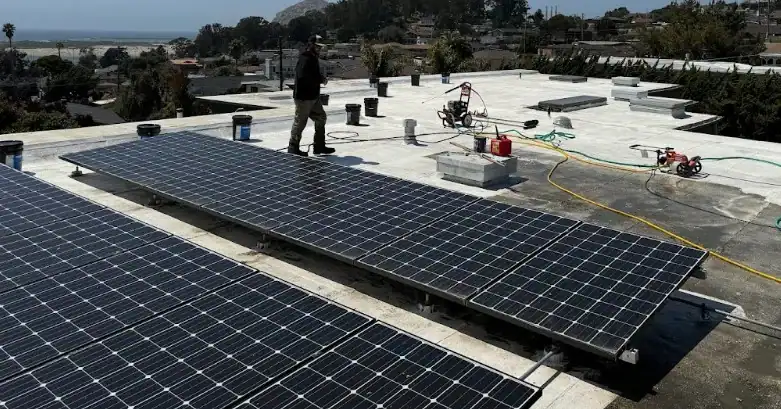
Planning Commercial Roofer Services Serving Nipomo California?
Creative Roofing handles building roofs with an eye on drainage, access and daily operations, for properties in Nipomo California and the surrounding area.
Phone 805-723-2381 to start planning the work with someone who knows low-slope roofs.
How Building Roofs Differ
Low slopes make a commercial roof a different problem from a house roof, and the failure modes are different too. Where a house roof sheds water by gravity, a flat roof depends on seams and drains, so installation craft counts for a great deal.
Tenants and staff notice a drip long before an owner sees the cause, and that makes prevention worth more than repair.
What Building Roofs Are Made Of
Rolled single-ply sheets are widely used because they are light, reflective and quick to install, and the details are worth a closer look. Modified bitumen sheets are heated or adhered in overlapping layers to make a durable surface, and the surface can be renewed with a coating or cap. Coated metal panels have become common on newer low-rise construction, and the right answer depends on what is already on the roof.
How Water Leaves a Building Roof
Water that sits on a membrane ages it faster than water that runs off, so inspections are best scheduled in late summer. Drains, scuppers and gutters collect water and carry it away from the building, so clearing drains is the cheapest maintenance on the list.
Equipment Is Where Leaks Start
Pipes, conduits and curbs interrupt the membrane in many spots, and many leaks start there rather than in the open field. Service technicians walking to equipment can wear a path through a membrane, and it is easy to overlook.
Reflective Roofs and Cooling Costs
Sun and heat are the steady stresses on a commercial roof in this part of California, and that is worth keeping in mind. Cooling load is one of the practical reasons building owners choose a reflective roof, and the details of the benefit depend on the building.
Planned Roof Care
A commercial roof lasts longest when someone looks at it regularly, and a written report builds a useful history. A visit usually covers drains, flashing, seams, curbs and the condition of the surface, and tenants never notice because nothing leaks.
Choosing the Right Level of Work
Not every aging roof needs a full tear-off, and testing is better than guessing. A roof that is wet inside cannot be coated or patched into good health, so a clear diagnosis matters.
Tenants, Customers and Noise
Roofers often work in phases so a store can stay open, and noisy work can be timed around business hours. Safety at the edge of a roof is a serious matter for the crew and for people below, and plan for parking and deliveries as well.
Comparing Commercial Roofing Proposals
A clear commercial proposal names the system, the thickness and the method of attachment, and the cheapest-looking option may leave things out. A contractor should be willing to explain how the work will be checked while it is in progress, and it is worth requesting before the work starts.
Finding the Source of a Commercial Leak
The wet patch indoors only tells you where the water finally escaped, and that is worth keeping in mind. Penetrations and terminations are the usual suspects, and fixing the cause stops the leak for good. Infrared and electronic surveys map wet insulation without cutting the roof apart, and the cost is small next to a wrong decision.
Holding the Roof Down
Strong seasonal winds pull hardest at the perimeter of a low-slope roof, and loose metal trim is an early warning. Perimeter metal is the first line of defense against uplift, so it deserves a look after any windy spell.
Walls, Parapets and Flashing Details
Flashing at the wall is one of the most failure-prone parts of a low-slope roof, and it is worth checking after every storm season. Cracks in a parapet cap or the wall below can feed water into the roof system, and ignoring it can undo a good roof.
Coatings Explained
Restoration coatings are meant for roofs that are still basically sound, and the right product depends on the existing membrane. Surface treatments help sound roofs, not ones that are failing underneath, and ask for the test results first.
When the Roof Covers an Acre
Materials arrive by the truckload and are lifted to the roof with cranes, so coordination with the building operator is essential. Multi-tenant buildings call for clear communication with every occupant, and the owner usually coordinates the work. Roofs over housing need extra care to keep people safe and informed, and it pays to think it through.
Spending Wisely on a Flat Roof
Thinking about the roof as a recurring cost makes budgeting easier, so the information from maintenance visits feeds the budget. The total cost covers upkeep, patching and the eventual new roof, and weigh the trade-offs honestly.
What Sits Between the Deck and the Membrane
The insulating layer is part of the roof system, not an afterthought, so keeping them dry is essential. Extra layers under the membrane help it resist wear from equipment and walking, so many owners include it. Slope built into the insulation is one of the cleanest ways to fix drainage problems, and few owners regret it.
Preparing a Building Roof for the Rainy Season
Written notes from each seasonal visit build a record that helps with budgeting and with conversations about replacement, and the visit takes only a short time.
Start With a Conversation
Anyone sorting out Commercial Roofer Services in Nipomo California is one call away from a straight answer, and 805-723-2381 reaches someone who can help. There is no pressure in asking questions about a roof, so reach out whenever you are ready. Putting off a roof decision seldom makes it simpler, and the conversation can be brief. The history of a roof matters when a building is sold or refinanced, so it pays to begin early.
Verified

Verified
Verified
Verified






















