
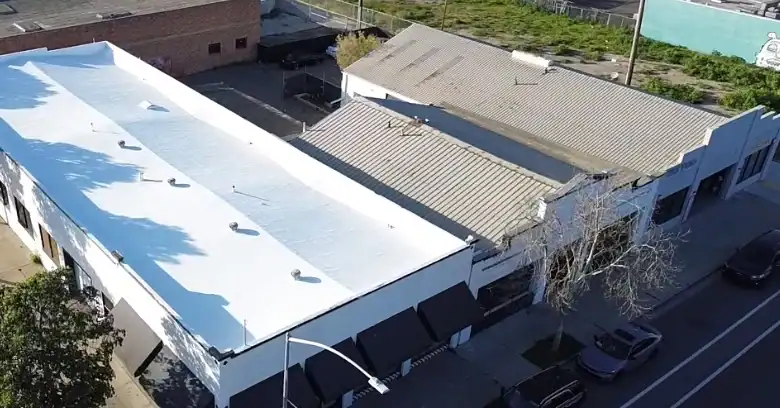
Considering Commercial Roofing for a Building in Nipomo California?
Creative Roofing looks after the roof over a business, from a small storefront to a large building, wherever a building needs a sound roof around Nipomo California.
Contact us at 805-723-2381 and tell us about the building and the roof.
What Sets a Commercial Roof Apart
The roof on a store or office is a working surface as much as a cover, and the tradesmen who work on them need specific experience. Flat roofs rely on continuous membranes with welded or glued seams, so installation craft counts for a great deal.
Buildings also carry people, stock and equipment that a leak can ruin, and a little care goes a long way.
The Membranes Used on Flat Roofs
Single-ply roofing arrives in large rolls and is joined at the seams on site, and the details are worth a closer look. Modified bitumen sheets are heated or adhered in overlapping layers to make a durable surface, and the layers add redundancy. Metal roofing is used on some commercial buildings, particularly those with a steeper pitch, so the building and its use drive the decision.
How Water Leaves a Building Roof
Ponding water speeds up wear and adds weight the structure has to carry, and drains need to be clear before the rainy season begins. Interior drains, edge scuppers and perimeter gutters each have their own failure points, and the first heavy rain turns it into a plug.
Air Conditioners, Vents and Curbs
Every unit on a roof is a potential entry point for water, so those details deserve the most attention in an inspection. Service technicians walking to equipment can wear a path through a membrane, and everyone benefits from the protection.
Heat Over a Working Building
Long dry summers expose a membrane to strong ultraviolet light month after month, and that is worth keeping in mind. Cooling load is one of the practical reasons building owners choose a reflective roof, and it pays to think it through.
Planned Roof Care
A planned visit twice a year is a common routine for building owners, and the best times are before and after the rainy season. Photographs from each visit help track changes over time, and tenants never notice because nothing leaks.
Repair, Coat or Replace
Localized damage can be repaired without touching the rest of the roof, and saving a good roof is cheaper than replacing it. Replacing only the surface over saturated insulation hides the problem without solving it, and surprises are the expensive part.
Tenants, Customers and Noise
A good plan keeps customers and staff away from the areas under construction, and early notice prevents most problems. Anyone entering the roof during construction needs to be accounted for, and plan for parking and deliveries as well.
Reading a Roof Proposal
The scope of work should list drains, flashing, curbs and any insulation to be added, and ask about anything that seems vague. Photographs and written records of the installation are useful for the owner, and keep it with the building records.
Why the Drip Is Never Where the Hole Is
Water travels along decking, insulation and ductwork before it shows up on a ceiling, and the real source is usually near equipment or an edge. The edges and the corners are where a flat roof tends to give way first, and it pays to think it through. Infrared and electronic surveys map wet insulation without cutting the roof apart, and a clear map makes planning easier.
Edges Are Where Roofs Let Go
The edges and corners of a flat roof take the highest wind loads, and repairs there should not wait. Perimeter metal is the first line of defense against uplift, and a small fix now prevents a large one later.
The Seams That Join Roof to Wall
Flashing at the wall is one of the most failure-prone parts of a low-slope roof, and the metal cap on top must stay sealed. Stucco, masonry and metal walls each need a different kind of termination, so it helps to look at the wall as well as the roof.
Fluid-Applied Systems
A coating can seal small cracks, reflect sunlight and slow the aging of the surface, so cleaning and repairing come first. Coatings cannot fix a roof with wet insulation or widespread damage, so be wary of anyone who promises it fixes everything.
Big Buildings, Big Roofs
A roof covering a very large area has special needs for drainage, access and safety, and the schedule can run many weeks. A leak in one unit may start above the next one down the line, and a single contractor for the whole roof keeps things simple. Residents expect notice before work begins above their homes, and it pays to think it through.
Spending Wisely on a Flat Roof
Thinking about the roof as a recurring cost makes budgeting easier, and regular inspections help estimate the timing. A cheaper system that fails sooner is not a bargain, and ask about the expected service life of each option.
Thermal Layers on a Flat Roof
Insulation under a flat roof keeps the building comfortable and reduces energy use, and wet boards lose most of their value. A thin board over the insulation spreads loads and gives the membrane a better base, and the added cost is modest. Slope built into the insulation is one of the cleanest ways to fix drainage problems, and the drawings show where the water will go.
Wind, Rain and Seasonal Readiness
Property managers who inspect their roofs before the rainy season avoid most of the emergency calls that come with the first heavy downpour, and a dry building is the reward.
Talk to Us About Your Building
A conversation about Commercial Roofing in Nipomo California usually starts with the age and type of the roof, and the number is 805-723-2381. Calling sooner rather than later keeps repair costs and disruption smaller, and the details are worth a closer look. People who manage property tend to value a straight answer about the roof above all, and the roof will show the rest. Good records and photographs make those conversations easier, and that starts with a good first inspection.
Verified

Verified
Verified
Verified






















