
Researching EPDM Roofing Around Santa Barbara California?
Creative Roofing knows how a roof without a pitch is built, why it leaks and how to make it last, for properties in Santa Barbara California and the towns around it.
Reach us at 805-723-2381 and tell us about the flat roof you have.
How a Flat Roof Differs From a Pitched One
A flat roof is never truly flat, but its slope is so slight that water drains slowly and lingers, and the quality of the seams decides everything. A flat roof gives little margin for error in the details, so it pays to hire people who work on flat roofs regularly.
What Goes on a Low-Slope Roof
Heat-welded sheets such as TPO are among the most popular choices for new flat roofs, and repairs are made by welding on a patch. A rubber roof is flexible and handles movement well, though seams and flashings need care, and the system suits many residential flat roofs. Built-up roofing, often called BUR, layers hot or cold asphalt with reinforcing fabric and finishes with gravel or a cap sheet, so the structure has to carry it.
Seams, Corners and Terminations
Most flat roof leaks start at a detail rather than in the middle of the roof, and the field is checked last. Termination bars and sealant hold the top edge of the membrane against the wall, and a small bead of sealant in time prevents a big repair.
Standing Water Is a Warning
Rain here often comes in sudden bursts that test every flat roof drain, and the first storm of the season shows the problems. Tapered insulation or added crickets can create the slope that a level roof lacks, and the improvement is permanent.
Cool Roof Coatings and Light Membranes
A flat roof faces the sky all day, and the sun heats it far more than a steep roof ever experiences, and a reflective finish lowers that stress. Silicone, acrylic and elastomeric coatings are the main families used on flat roofs, and the preparation is as important as the product.
What Happens Around Machinery
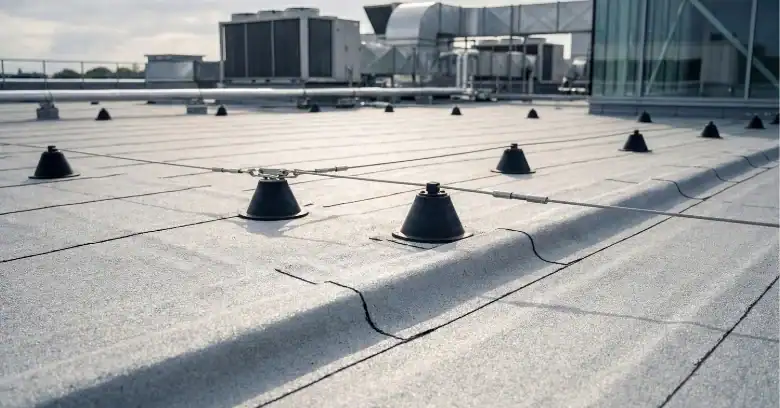
Boots, pitch pockets and flashing collars around pipes must be sound and sealed, and plugging with caulk is only a stopgap. Walkway pads cost little and save the membrane from scuffing and punctures, and a quick look after any service visit catches new damage.
Options for an Aging Flat Roof
A flat roof with a few leaks and a sound membrane can often be repaired for a fraction of the cost of replacing it, and temporary fixes should be called what they are. These options depend on the condition of the insulation under the old surface, and wet insulation rules out a quick fix. Starting fresh gives the best foundation for another long stretch of service, so begin conversations before the leaks become urgent.
Residential Low-Slope Roofing
Many homes combine a pitched main roof with flat sections at the back or the sides, and the two meet in a joint that needs careful flashing, and the wrong material on a flat roof will leak. Leaks that appear in the room next to an addition often trace back to this single joint, so look at the wall as well as the roof. A roof used as living space has to meet higher standards than one that nobody walks on, and the details are worth a closer look.
Energy and the Low-Slope Roof
Insulation values and reflective finishes work together to keep the space below comfortable, and a light-colored membrane adds to the benefit. A moisture survey with a meter or an infrared camera can map the wet areas without tearing the roof apart, and the map is a useful record.
Before the Rains and After the Storms
A check in early autumn catches clogged drains, lifted seams and cracked sealant before the first storm tests them, and a small repair now is nearly always cheaper. After a heavy storm or a spell of high wind, a quick look from a ladder can show whether anything has shifted, lifted or collected on the surface, so do not wait to see whether it dries out.
Edges Take the Brunt
Whether a membrane is fully adhered, mechanically fastened or held down by ballast, the edges are the place where the installation either succeeds or fails, so ask how the edges will be attached. Raking the gravel back into an even layer is a routine job that keeps the protection continuous, and the details are worth a closer look. The more complicated the roof, the more a clear written scope matters, since each detail represents a possible source of dispute, and point out anything unusual.
Openings That Need Their Own Waterproofing
A curb lifts the opening above the level of standing water, which is the main reason it exists, and the membrane must climb it and be sealed at the top, so ask how every opening will be handled. Flexible parts crack in strong sun over a few seasons, which is why penetrations leak long before the membrane does, and mark each one on a sketch. Drains and scuppers are also penetrations, and the flashing around them has to be watertight while still letting the water through quickly, and clear them after storms.
Reading Competing Bids
A bid that only says new flat roof does not tell you what you are buying, and the details are worth a closer look. Ask who will supervise the work and how weather delays will be handled, so write down what each company says.
What to Expect on the Days of the Work
Workers on a low-slope roof often arrive early, because the surface heats up quickly and some products behave better in the cool of the morning, so ask how the schedule will work.
Questions Owners Often Ask About Level Roofs
A roof with no visible slope is not necessarily failing, since most are designed with a gentle fall toward the drains, and it pays to think it through.
Talk to Us About Your Flat Roof
A conversation about EPDM Roofing in Santa Barbara California usually starts with the type and age of the roof, and the number is 805-723-2381. Whether the roof is leaking now or you are planning ahead, an early conversation keeps your options open, and we are glad to help you sort it out.
Verified

Verified
Verified
Verified
Verified






















