
Planning New Roofing Maintenance Around Santa Barbara California?
Creative Roofing covers each step of putting a new roof on a house, across Santa Barbara California and the neighboring communities.
Dial 805-723-2381 and tell us what has you thinking about the roof.
The First Step in a Roofing Project
The first visit is about gathering facts rather than picking a product, and that is worth keeping in mind. Loose granules, lifted edges, cracked flashing and soft spots all say something about the layers below, and it pays to think it through.
Months of direct sun take a steady toll on whatever covers a house, and a roofer who knows the area expects exactly that.
Deciding What the Roof Needs
The right answer depends on how much sound material is left on the house, and the reasons should be easy to follow. Ask to see the problem areas, either in photographs or from the ladder, since the plan should make sense to the person paying for it.
Hidden damage found during tear-off is the usual reason a project grows beyond its first outline, and it helps to know that before the work begins.
Shingle, Tile or Metal
The common choices are shingle, tile and metal, and each suits some houses better than others, and the style of the neighborhood often plays a part. Color deserves more thought than it usually gets, and it pays to look at them at different times of day.
Timing the Work
Roof work is easiest to schedule in the long dry stretch between rains, and a careful crew never leaves an opening to chance. Crews often start early in summer to get ahead of the hottest hours, so the day usually begins at sunrise.
Tear-Off and Preparation
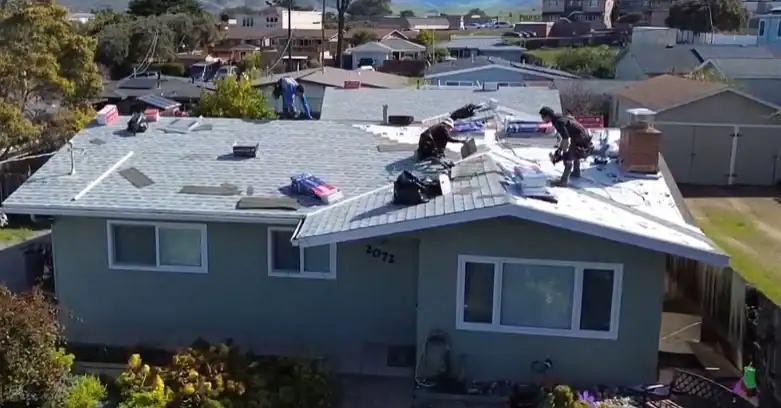
Taking the old roof off is the noisiest and messiest part of the job, and magnets and rakes pick up the nails that fall. Soft or split sheathing is cut out and new panels are fastened down, so this is not the place to save time.
Protection Under the Covering
Underneath the visible covering sits a water-resistant layer that does much of the work, and metal edging is set at the eaves and rakes before the covering. Drying in gives the crew a margin against surprise weather, and the finished surface is installed over a sound base.
Penetrations and Edges
Flashing is the thin metal that keeps water out where the roof meets something else, and reusing old flashing under a new roof often comes back to bite. Vent boots and pipe collars are rubber or lead pieces that wear out before the roof does, and putting in new boots costs little when the roof is already open.
Keeping the Attic Cooler
A roof without enough ventilation bakes the attic and everything stored in it, and vents at the eaves let cooler air in. Adding vents at random may do little more than cut holes in the roof, and a roofer should be able to describe it simply.
Leaving the Property Clean
Final cleanup means more than a quick sweep, and covers come off the landscaping and the beds are inspected. Keeping a short record of the materials used helps with later maintenance, and it makes future repairs and sales smoother.
Local Rules and Paper Trails
Rules about reroofing differ from one city to the next, and a little care goes a long way. Certain hillside and edge-of-town areas follow stricter material rules than the valley floor, and a roofer working in the area should already know them. A clear proposal lists what will be removed, what will be installed and what happens if the deck needs work, so compare any two side by side.
Protecting the House and Yard
Roof work is hard on landscaping unless it is planned for, and a careful crew sets them before the work begins. Pets, children and cars are best kept away from the work area, and keep a path clear for deliveries. Attic contents are best covered or moved before the work starts, and a little care goes a long way.
Disruption and How to Manage It
Timing depends on the size of the roof, the complexity of the layout and the covering chosen, and plan on some slack for the weather. Informing nearby households is a courtesy that pays off, and it is easy to overlook. The loudest stretch is the tear-off, and it passes quickly, so consider a day out of the house if you can.
A Short List for Comparing Proposals
Ask how the crew protects the house when rain is in the forecast, and write the answers down. Ask for the materials by name and manufacturer so you can look them up, and a good roofer will be glad you asked. A change in scope should be written down and approved before the work continues, and settle it before the first day.
Maintenance After the Job
Even a new roof benefits from an occasional look from the ground, and binoculars make the job easy. Trim branches that touch or hang over the roof, and that is worth keeping in mind. Early attention to a leak is almost always cheaper than late attention, and the earlier the better.
Choosing the Right Season
Waiting for the first storm to find the weak spot means hiring in a hurry, and the schedule fills quickly once the rains end. Early fall is popular because the weather is still dry and the heat has eased, and a good roofer will explain the trade-offs.
Roof Work and Your Attic
The attic is the roof as seen from below, and it often gives the clearest picture of how the roof has been performing, so ask the roofer to look inside as well.
Getting Started in Santa Barbara California
Questions about New Roofing Maintenance in Santa Barbara California begin with a short phone call, so dial 805-723-2381 and say what you are seeing. The size of the project changes the schedule but not the principle, so there is no harm in asking questions first. A short conversation can turn a vague worry into a clear plan, and that is a good place to begin.
Verified

Verified
Verified
Verified
Verified






















