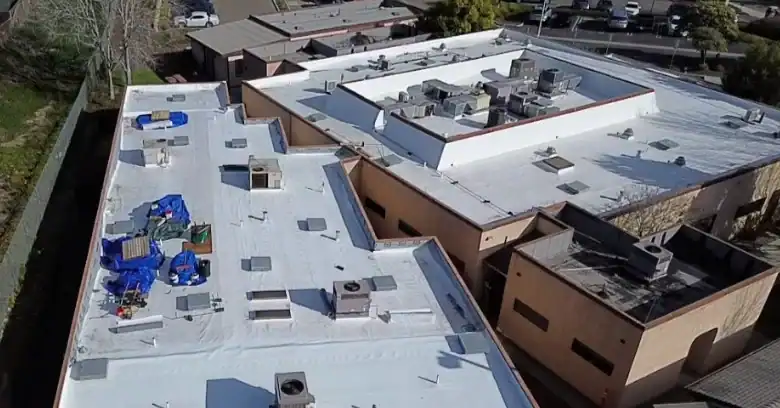
Weighing TPO Membrane Roof Services Around Santa Maria California?
Creative Roofing handles the seams, drains and edges where a flat roof succeeds or fails, serving owners in Santa Maria California and beyond.
Ring 805-723-2381 and we will explain the options for a level roof.
Why Flat Roofs Need Special Care
A flat roof is never truly flat, but its slope is so slight that water drains slowly and lingers, so shingles are never the answer. Standing water multiplies every defect and speeds up aging, and the cost of a mistake is paid in repairs.
What Goes on a Low-Slope Roof
White single-ply membranes reflect sunlight and help keep the building cooler, and repairs are made by welding on a patch. The big rolls of rubber cover large areas with few seams, and the seam tape is a point to watch over time. Built-up roofing, often called BUR, layers hot or cold asphalt with reinforcing fabric and finishes with gravel or a cap sheet, and the gravel hides the condition of the membrane.
Seams, Edges and Where Leaks Start
Seams, corners, edges and penetrations are where problems begin on a low-slope surface, and that is worth keeping in mind. Where a flat roof meets a wall, the membrane must turn up and be sealed and capped with flashing, so look at those joints every year.
Keeping a Level Roof Drained
A roof that holds puddles is telling you about a low spot or a blocked drain, and a little care goes a long way. Tapered insulation or added crickets can create the slope that a level roof lacks, so ask for a plan to improve drainage.
Sun, Heat and Reflective Surfaces
Heat makes a membrane expand during the day and shrink at night, and the movement stresses seams and fasteners. A white or reflective coating can lower the surface temperature and protect the membrane beneath, so cleaning and repair come first.
What Happens Around Machinery
These openings are the most common leak sources, so they get the most attention in an inspection, so these spots deserve regular checks. Regular foot traffic wears a path in the surface unless it is protected, so ask the roofer to mark and protect the routes.
Choosing How Far to Go
Localized seams, flashings and punctures can be fixed without touching the rest of the roof, so ask to see where the water is getting in. Testing for moisture shows what the roof can accept, and it is easy to overlook. A new roof is also a chance to improve slope, drains and edges, and ask about drainage improvements in particular.
Level Roofs at Home
Many homes combine a pitched main roof with flat sections at the back or the sides, and the two meet in a joint that needs careful flashing, and it pays to think it through. A bead of caulk across that joint might hold for a season, but a proper counterflashing is the lasting answer, and fixing it properly takes some patience. Roof decks and patios built over living space need a waterproofing layer under the finished surface, and a failure there can be expensive to reach, and avoid fastening anything through the membrane.
Heat Gain and Thermal Layers
Because there is often little or no open space under the deck, heat from a hot summer day passes quickly into the rooms below unless the roof is well insulated, and the savings show up in the cooling bill. Wet insulation loses most of its ability to resist heat and adds weight the roof was never meant to carry, so ask whether a survey is part of the process.
Keeping a Flat Roof in Shape Through the Year
The best time to look at a flat roof is at the end of the dry season, when leaves and debris have piled up and the rains are about to test every drain, and call a roofer if anything looks suspicious. A stain on a ceiling after a storm is a clear signal to have the roof inspected before the next one arrives, and it pays to think it through.
Securing the Roof Against the Wind
Seasonal gusts pull hardest at the perimeter of a low-slope roof, so the fastening pattern is tighter along the edges than in the middle of the field, and expect a specific answer. Ballasted roofs hold the membrane down with a layer of smooth stone or pavers instead of glue or fasteners, and the weight is part of the design, so inspect the outlets after any disturbance. Walkways, curbs and equipment supports need to be flashed and fastened as part of the membrane, and the details on a crowded roof take real time to do properly, and write everything down.
Openings That Need Their Own Waterproofing
Replacing a worn skylight and its curb flashing together with the roof is far cheaper than doing the two jobs separately, and that is worth keeping in mind. Flexible parts crack in strong sun over a few seasons, which is why penetrations leak long before the membrane does, and every opening is one more detail to watch. Drains and scuppers are also penetrations, and the flashing around them has to be watertight while still letting the water through quickly, and a blocked outlet loads a roof beyond its design.
Questions for a Flat Roof Contractor
A bid that only says new flat roof does not tell you what you are buying, and the details are worth a closer look. Find out how drainage will be addressed and whether tapered insulation is included, and notes help you compare.
Access, Fumes and Noise
Hot-applied and adhesive systems give off smells while they cure, so windows and vents near the work area are usually closed for a day, and a short conversation beforehand covers the details.
Clearing Up a Few Misconceptions
A roof with no visible slope is not necessarily failing, since most are designed with a gentle fall toward the drains, and bring photographs if you have them.
Talk to Us About Your Flat Roof
Owners weighing TPO Membrane Roof Services in Santa Maria California can begin by describing the building and the roof they have, and the number is 805-723-2381. Whether the roof is leaking now or you are planning ahead, an early conversation keeps your options open, so reach out whenever you are ready.
Verified

Verified
Verified
Verified