
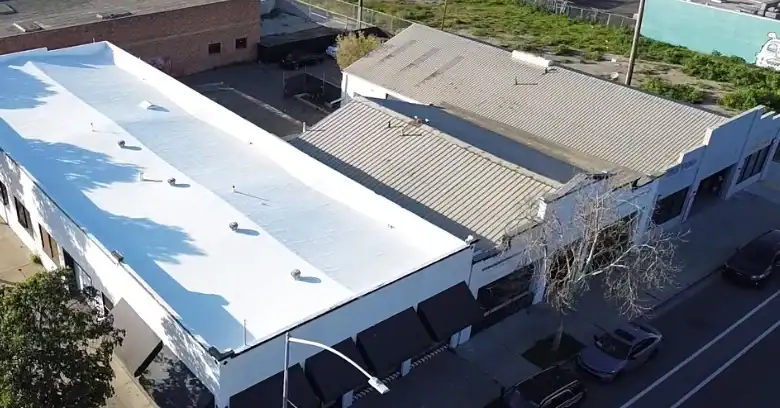
Considering Commercial Roofing Contractors Near Me in Santa Maria California?
Creative Roofing works on the roofs of shops, offices, warehouses and apartment buildings, for properties in Santa Maria California and the surrounding area.
Call 805-723-2381 and describe what is happening up there.
Roofs Over Businesses
Low slopes make a commercial roof a different problem from a house roof, and that is worth keeping in mind. A low-slope roof has to be sealed, not just overlapped, and there is little margin for sloppy work.
Water coming through a commercial roof can reach inventory, electrical gear and computers, so planning ahead is the practical approach.
What Building Roofs Are Made Of
Single-ply roofing arrives in large rolls and is joined at the seams on site, so the choice affects how repairs are done later. Built-up roofs use alternating layers of asphalt and reinforcing fabric, finished with a surface of gravel or a cap sheet, and it is easy to overlook. Standing seam metal panels cover warehouses, schools and retail buildings, and each option has conditions where it works best.
Where the Rain Goes
A roof that holds puddles after rain is telling you something, so inspections are best scheduled in late summer. Drains, scuppers and gutters collect water and carry it away from the building, and an overflow scupper is a backup that should never be blocked.
Air Conditioners, Vents and Curbs
Mechanical equipment on the roof creates dozens of places where the membrane has to be cut and sealed, and many leaks start there rather than in the open field. A roof that has regular service visits needs protection along the paths, and a few walkway pads cost little compared with a patch.
Strong Sun on a Flat Surface
Sun and heat are the steady stresses on a commercial roof in this part of California, and the surface slowly dries, chalks and cracks. Cooling load is one of the practical reasons building owners choose a reflective roof, and the details of the benefit depend on the building.
Small Jobs That Prevent Big Ones
Routine care costs a fraction of an emergency repair, and a written report builds a useful history. Photographs from each visit help track changes over time, and the results show up in fewer emergency calls.
Choosing the Right Level of Work
The right answer depends on how much of the system is still dry and sound, and testing is better than guessing. A roof that is wet inside cannot be coated or patched into good health, and the cost of delay grows with every storm.
Scheduling and Safety
Many commercial roofs are replaced in sections so that the building is never left open, and it pays to think it through. Fall protection is required on commercial roofs, and a professional crew uses it, so ask how the site will be protected.
Reading a Roof Proposal
A clear commercial proposal names the system, the thickness and the method of attachment, and the cheapest-looking option may leave things out. Photographs and written records of the installation are useful for the owner, so make it part of the agreement.
Leak Detection on a Flat Roof
Tracing a leak on a low slope takes patience, because water wanders, and the real source is usually near equipment or an edge. The edges and the corners are where a flat roof tends to give way first, and it pays to think it through. Infrared and electronic surveys map wet insulation without cutting the roof apart, and a clear map makes planning easier.
Wind, Fasteners and Roof Edges
Gusts act on a roof like air over an aircraft wing, trying to lift it, so careful edge details are a mark of good work. A strip of metal that has come away is an invitation for wind and water, so it deserves a look after any windy spell.
Terminations and Transitions
Flashing at the wall is one of the most failure-prone parts of a low-slope roof, and that is worth keeping in mind. Cracks in a parapet cap or the wall below can feed water into the roof system, and it pays to think it through.
Giving an Older Roof More Time
Restoration coatings are meant for roofs that are still basically sound, and the preparation matters as much as the product. Coating over a wet roof is a common and costly mistake, so be wary of anyone who promises it fixes everything.
Scale Changes the Planning
Big projects need a plan for storage, staging and phasing, and weather windows matter more at this scale. Multi-tenant buildings call for clear communication with every occupant, and that is worth keeping in mind. Apartment and multifamily buildings add residents, balconies and shared walkways to the mix, and noisy work is timed with consideration.
The Long View on Roof Spending
A commercial roof is a major capital item that is best planned years ahead, so the information from maintenance visits feeds the budget. The total cost covers upkeep, patching and the eventual new roof, and ask about the expected service life of each option.
The Layers Below the Surface
Most commercial roofs have rigid insulation boards between the deck and the waterproofing, and replacing them is part of many re-roof projects. Extra layers under the membrane help it resist wear from equipment and walking, and the added cost is modest. Tapered insulation can create slope on a roof that is otherwise dead flat, and the drawings show where the water will go.
A Seasonal Checklist for Managers
A pre-season checklist includes clearing drains and scuppers, checking seams and flashing, and photographing the condition of the surface, so schedule it like any other maintenance.
Ready to Look at the Roof
Managers researching Commercial Roofing Contractors Near Me in Santa Maria California are welcome to call and ask questions, so use 805-723-2381 to set up the next step. There is no pressure in asking questions about a roof, and the first step is a simple phone call. A visit to the property turns a general worry into a specific plan, and it is easy to overlook. Property managers often juggle many buildings and appreciate clear, written answers, and that starts with a good first inspection.
Verified

Verified
Verified
Verified
Verified






















