
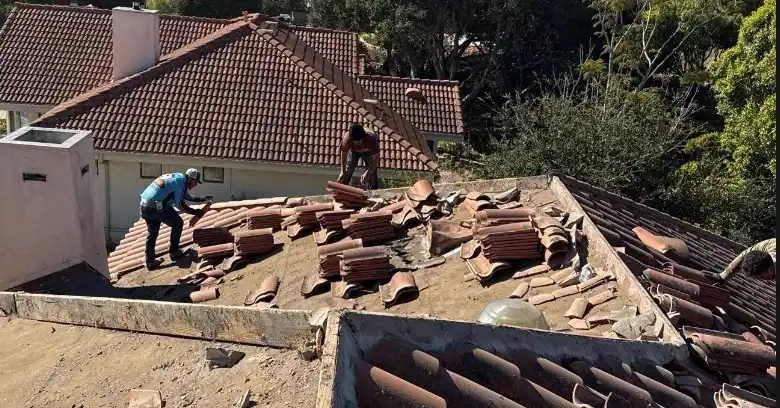
Thinking About Tile Roofers in Arroyo Grande California?
Creative Roofing installs, repairs and re-sets the heavy, long-lived coverings found on many homes in the region, serving homeowners in Arroyo Grande California and beyond.
Call 805-723-2381 to set up a visit to look at your roof.
Basics of a Roof Built From Individual Pieces
Fired clay and molded concrete are the two materials used for the heavy, durable coverings found across the region, so the layers below matter more than most people expect. Natural clay holds its color for a very long time, while concrete may need more attention to its finish, and the look varies enormously.
Weight, Framing and What the House Can Carry
The framing is the foundation of any heavy roof, so a visual check is where the process begins. Adding weight without adding support invites cracks, sagging and even failure, and a careful contractor raises the issue unprompted.
Underlayment Is the Real Waterproofing
Water gets under the pieces during wind-driven rain, and the underlayment carries it down and out, and it ages in the heat trapped under the pieces. Sun and heat trapped under the units bake the underlayment for years, until it dries, cracks and fails, and high-temperature types are worth the small extra cost.
How Heat Behaves Under the Pieces
Air circulating under the curved shapes helps keep the house cooler in summer, and it pays to think it through. Efflorescence, a white powdery bloom, can show on concrete units and is mostly cosmetic, so ask before assuming the roof is failing.
Why Pieces Break
Falling branches and windblown debris can also crack pieces in a storm, and waiting makes the repair more expensive. Asking other trades to avoid walking on the roof prevents a lot of broken pieces, and the cost of a few replacements is small.
Hand-Shaped Metal and Mortar
Flashing along walls, chimneys and skylights has to be formed and shaped by hand around each piece, so look at how the work is finished. Ridge and hip pieces are bedded in mortar or fastened with mechanical systems, and the old mortar often fails before the roof does, so look for loose or missing cap pieces.
Wildfire Season and Fire Resistance
Some systems use a mechanical clip at every piece, while others rely on adhesive along the edges, and a little care goes a long way. Embers do not ignite the pieces, though they can still collect in gaps and under the edges, so ask how gaps will be kept closed.
Repair, Re-Lay or Replace
Many of these roofs are restored two or three times over the life of the building, and the savings from a re-lay can be considerable. Replacing the covering gives the chance to upgrade the structure, the ventilation and the details, and a good roofer will lay them out plainly.
Holding the Pieces Together
Modern installations often replace mortar with clips, screws or flexible adhesive that tolerate movement without failing, and the method should be named in the proposal. A missing eave closure is easy to spot from the ground as a dark gap along the lower edge of the roof, and a little care goes a long way.
Cleaning a Heavy Roof Without Damaging It
Surface growth tends to be slower in dry summers, though shaded areas may still collect some, so consider it before deciding to replace. Cleaning is not a substitute for repairs, but it often reveals cracked pieces that were hidden by grime, and it is easy to overlook.
A Better Base for a Long-Lived Roof
Heavy felt, synthetic sheets and self-adhering membranes are the common options, and they differ in heat resistance and tear strength, so ask which product is specified. Battens that lift the units off the underlayment allow air to circulate and water to drain freely beneath the pieces, so look for it in the proposal.
Solar Panels, Skylights and Heavy Roofs
Special hooks and flashing kits exist for these roofs, and an installer who uses them keeps the surface watertight, and ask who is responsible for the seals. Service technicians for air conditioning and chimney sweeps should be told to step only where the roof can bear a person, so make it a habit to ask about the roof. Metal valley liners should be inspected for rust, pinholes and loose edges, since they carry more water than any other part of the roof, and a ladder and a soft broom are often all you need.
Two Materials, Two Personalities
Cast from cement and sand, concrete units take their color from pigment in the mix or from a coating applied to the surface, and the difference shows up in the details. Barrel tiles are laid in alternating channels and caps, while interlocking units are single pieces that lock together along their edges, and think about the neighbors as well.
How to Weigh Two Bids
A proposal that only says re-lay the roof does not tell you enough, so ask for them before signing. Ask how the crew will handle the pieces, where they will be stored and how breakage will be managed, and keep notes to compare later.
What Happens on Site
Work in stages keeps the house covered at the end of every day, so that a sudden rain does not find an open roof, and the crew has to be careful with every piece.
What to Do Before Summer Ends
Clearing leaves and needles from valleys, gutters and the back of chimneys removes fuel that could ignite from a flying ember, so make it part of the late-summer routine.
Records, Photographs and Spare Pieces
Passing these records to the next owner of the house adds real value and saves them a good deal of guesswork, and a clear record makes repairs simpler.
Tell Us What You Are Seeing
People researching Tile Roofers in Arroyo Grande California are welcome to call with questions, so dial 805-723-2381 when it suits you. Planning ahead usually leads to better choices than reacting to an emergency, and the first step is just a phone call.
Verified

Verified
Verified
Verified
Verified






















