
Looking for Residential Roofing Companies Near Central Coast California?
Creative Roofing stays with a roofing project from the first walk-around to the final check, across Central Coast California and the neighboring communities.
Ring 805-723-2381 and tell us what has you thinking about the roof.
The First Step in a Roofing Project
Before any material is chosen, the existing roof has to be understood, and that is worth keeping in mind. Photographs taken on that first visit become the record for everything that follows, and it pays to think it through.
Sunny slopes and shaded slopes tell different stories, and both matter, so the wear is rarely even from one side to the next.
Choosing How Far to Go
A roof can be repaired, partly rebuilt or removed entirely, and the evidence decides what is done, and the recommendation should come with the reasons attached. A roofer who explains the reasoning in plain terms is easier to trust with the work, and the answer tells you a lot.
When the decking underneath is damaged, the scope of the job grows, and it is easy to overlook.
Choosing Materials for Your Home
The common choices are shingle, tile and metal, and each suits some houses better than others, and the pitch of the roof narrows the field quickly. Lighter colors reflect more of the summer sun, while darker ones soak it up, and that is worth keeping in mind.
Planning for Rain and Heat
Rain arrives in bursts, and a roof that is open when one comes needs protection, and crews watch the forecast closely. Crews often start early in summer to get ahead of the hottest hours, and a little care goes a long way.
Removing the Old Roof
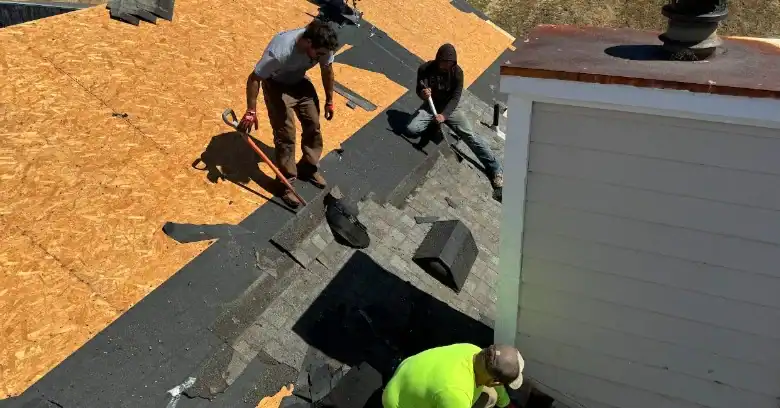
The existing covering is stripped away and the deck is left exposed for inspection, and magnets and rakes pick up the nails that fall. The deck is checked, mended and made flat for the next layer, and skipping the step shortens the life of an otherwise good roof.
What Goes Down First
Underneath the visible covering sits a water-resistant layer that does much of the work, so self-adhering membrane goes where leaks tend to begin. Once the underlayment is down, the house is considered dried in, and rows are laid from the eave upward, each lapping the last.
Penetrations and Edges
Water finds the joints first, so flashing matters, and the cost is small next to the roof it protects. Sun dries and cracks the flexible parts over time, so replacing them along with the roof removes a predictable problem.
Attic Airflow
Warm air trapped under the deck works on the roof from below, and the details are worth a closer look. A ventilation plan is worth a conversation before the job starts, and it is easy to overlook.
Finishing the Job
Final cleanup means more than a quick sweep, and that is part of the work, not an extra. Questions are easier to settle while the crew is still on site, and it pays to think it through.
The Paperwork Side of a Roof
Depending on the town, a re-roof may need a permit before any material is ordered, so it is fair to ask who pulls the permit. Wildfire concerns have changed what many local codes ask of a roof, and a roofer working in the area should already know them. A clear proposal lists what will be removed, what will be installed and what happens if the deck needs work, and it is worth reading it slowly.
Looking After Your Property During the Work
Heavy materials, ladders and falling pieces all share the space around the walls, and a careful crew sets them before the work begins. Moving vehicles out of range for the day is a simple precaution, and a short talk the evening before covers the details. Inside the house, vibration can shake items from shelves and loosen attic insulation, and a sheet over stored boxes keeps the grit off.
What the Household Should Expect
A simple roof may go quickly while a complicated one takes longer, so ask for the expected start and finish up front. Roof work is loud, and the street will hear it, and it is easy to overlook. Working from home during a roof job is possible, though not always pleasant, and a plan for the loud days makes them easier.
Getting Clear Before the Work Begins
Ask how the roof will be ventilated and how the flashing will be handled, and listen to how the answer is given. Ask for the materials by name and manufacturer so you can look them up, and it should be written on the proposal. Talk through how changes to the plan will be handled and agreed, and it is better to know in advance.
Looking After a New Roof
A roof needs less attention than most parts of a house, but it needs some, and little problems stay little. Trim branches that touch or hang over the roof, and it protects the investment you just made. A prompt visit after damage keeps a minor repair minor, and a photograph helps explain what you saw.
Spring, Summer or Fall
Many homeowners wait until a leak appears before they think about a roof, and a little care goes a long way. Any month can work with the right planning and a willingness to move a day, so do not feel the choice is locked in.
Insulation, Ducts and Cables Under the Roof
Insulation in the attic that is compressed, wet or missing should be noted, since a new roof is a good time to fix the whole assembly, and the findings can change the scope.
Talk to Us About Your Roof
Anyone researching Residential Roofing Companies in Central Coast California is one call away from a straight answer, and 805-723-2381 reaches the right person. The size of the project changes the schedule but not the principle, and an early conversation costs little. Putting off a roof question rarely makes it easier to answer, and the next step becomes obvious.






















